


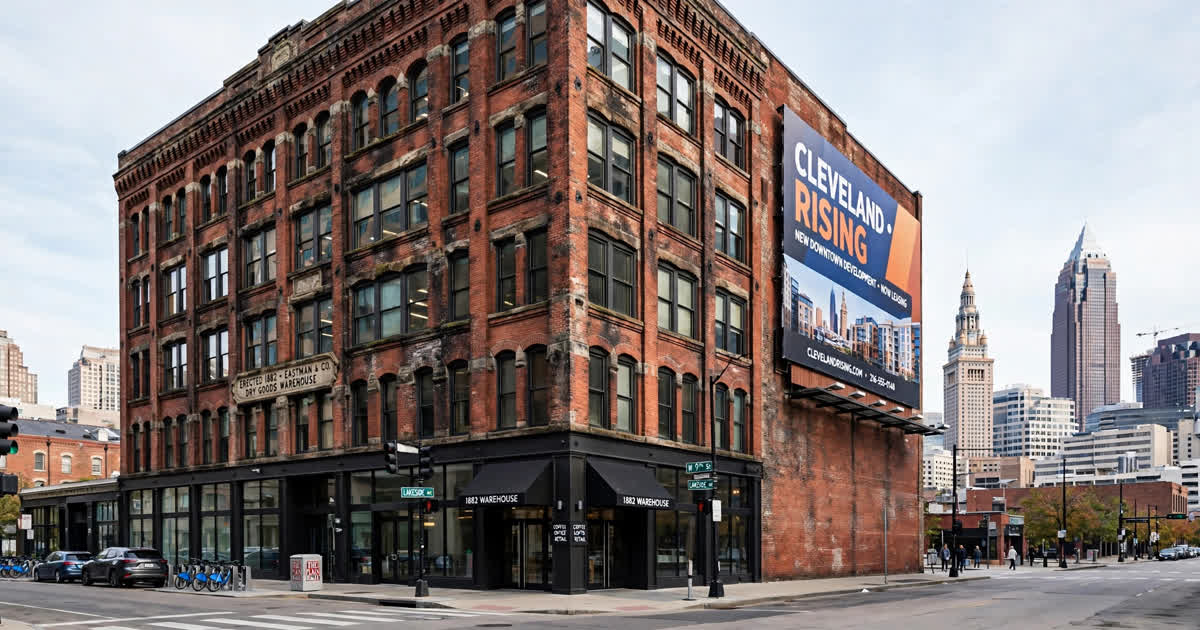
A five-story Cleveland Warehouse District building raised in 1882 for a printing company could be demolished under a permit application filed with the city’s Building Department on Friday, with the city’s Landmarks Commission holding the final say, according to reporting by NEOtrans published through a content-sharing agreement with Cleveland Magazine.
The application proposes demolishing the Gilman Building at 1350 W. 3rd St., an 18,290-square-foot commercial structure, at an estimated demolition cost of $282,000, NEOtrans reported. It was submitted on behalf of property owner 1350 W III LLC, an affiliate of Welty Enterprises of suburban Akron, by Randall Parsons, president of Akron-based AVID Architects Inc., who paid the $150 filing fee, according to NEOtrans.

No reason for the demolition has been given. NEOtrans reported that it reached out to Welty Development President Tom Charek and to Kenneth Landenberger, general manager of commercial leasing and facilities at Welty, without any response, and that Parsons also did not reply.
To win city approval for a downtown demolition, an applicant must provide plans for what land use would replace the demolished structure, with parking lots allowed only as an interim use, NEOtrans reported. No plans or attachments were submitted with Friday’s application, although the applicant said they would be submitted electronically later.

Because the Warehouse District is a historic district, any demolition there faces greater scrutiny and is often denied when a building is stable, historic, architecturally significant or contributing to the district, NEOtrans reported. City and Cuyahoga County records list the Gilman in good condition; it was last renovated in 2004 by Stark Enterprises for its headquarters and has no pending building code violations, according to NEOtrans.
The building was built in 1882-83 for the A.S. Gilman Printing Co. and designed in the Victorian style by John Edelmann, a mentor to famed architect Louis Sullivan, the “Father of skyscrapers.” NEOtrans reported that the Gilman and New York City’s Decker Building, built in 1893, may be the only two surviving monuments to Edelmann’s work.

The Gilman’s historic facade was modernized and re-clad in the late 1960s, which cuts both ways in the case ahead. Tom Yablonsky, an advisor to the Historic Warehouse District Development Corp. and its former executive director, told NEOtrans the building has been altered so much over the decades that it might not be eligible for historic protections — but he also said other preservation consultants have found that the 19th-century exterior remains underneath the 1960s and 2004 modernizations and could be restored, and that the Landmarks Commission would have the final say.
“It’s worth checking,” Yablonsky told NEOtrans. “We need to protect the surviving building stock in the Warehouse District.”

Welty acquired the property in 2021 for $3,375,000 from the Realife Real Estate Group and used it as a construction field office for the neighboring Sherwin-Williams headquarters project, where a Welty joint venture with the Gilbane Building Co. served as construction manager of the 1.1-million-square-foot headquarters, NEOtrans reported. The Gilman carries a large billboard on its windowless west side that produces steady revenue, and it has not been marketed for new office or retail tenants in five years, according to NEOtrans.
Parking pressure hangs over the discussion. Rico Pietro, a principal at the Independence-based brokerage Cushman & Wakefield | CRESCO, which last marketed the Gilman, told NEOtrans that parking is in high demand in the Warehouse District since the Sherwin-Williams headquarters opened, and scarcer still after a 350-space lot farther west on St. Clair Avenue was sold to the Ohio Bureau of Workers Compensation. But on the Gilman’s 3,658-square-foot footprint, demolition might yield only 10 to 12 parking spaces, NEOtrans calculated. There are no public records indicating Sherwin-Williams is acquiring the Gilman now, and Julie Young, the company’s vice president of global corporate communications, did not respond to NEOtrans before publication.
The demolition question reaches the Landmarks Commission as Northeast Ohio building owners weigh old structures against new investment, a tension playing out from a 20-fold manufacturing expansion in Macedonia to broader questions about downtown’s future raised by Cleveland’s falling poverty rate and strain on small departments like Newburgh Heights police.
What we know — and what we’re still waiting on. We know a demolition permit has been applied for, that the building is listed in good condition, and that the Landmarks Commission decides its fate. We do not yet know why the owner wants it down, what would replace it, or when the commission will take the application up — the replacement plans the city requires had not been filed with Friday’s application.
What happens next is procedural: the applicant is expected to submit its replacement plans electronically, and the Landmarks Commission will then weigh whether a 143-year-old piece of the Warehouse District’s surviving building stock can come down. Until it rules, the Gilman Building stands.