


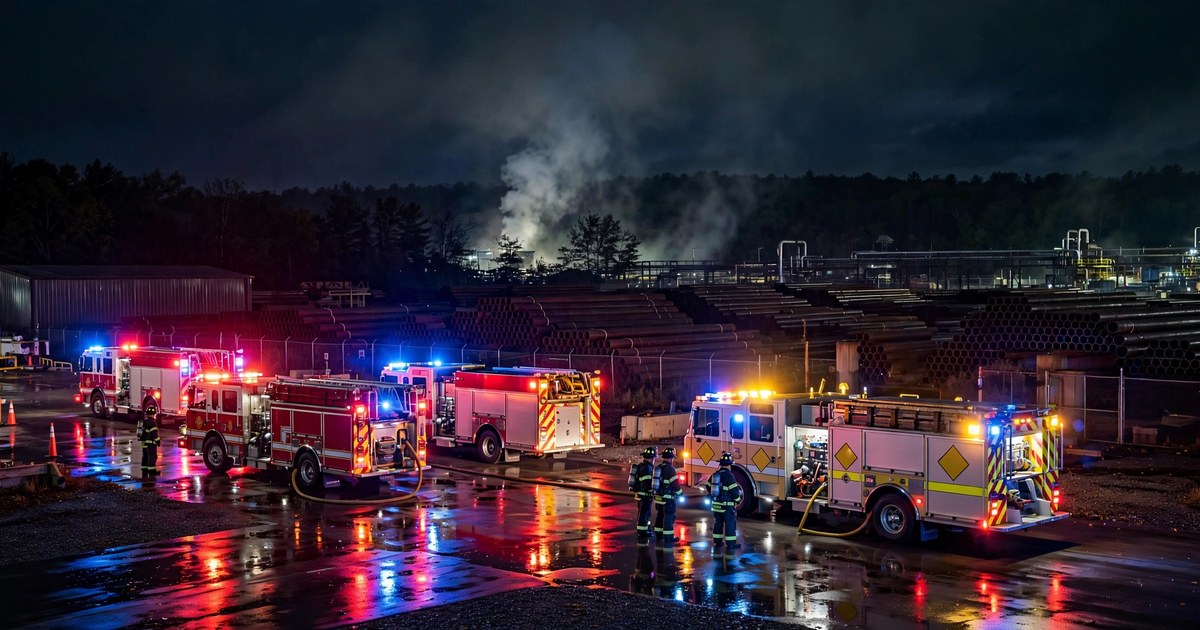
Officials can describe the response to Tuesday night's glycidyl methacrylate release in detail. They have not said how much got out — and no air reading for the chemical itself has been made public.
TOLEDO, Ohio — More than a day after a damaged tank at a Toledo trucking terminal began releasing a hazardous industrial chemical into the night air, the most basic question of the incident remains unanswered in every official statement issued so far: how much of it escaped.
The chemical is glycidyl methacrylate, used in coatings, adhesives and plastics. The tank it came from, at the MC Tank Transport terminal at 1266 Progress Ave. in North Toledo, held a capacity of 5,500 gallons, according to the Ohio EPA. That figure — capacity — is the only volume any agency has released. How much was in the tank Tuesday night, how much entered the air or the ground, and how much, if any, was contained has not been disclosed by the city, the Ohio EPA, the U.S. EPA or the company, as of Thursday morning. The gap matters, because the other questions residents are asking — how far the plume could travel, whether sheltering indoors was enough, what the chemical does to a person who swallows it — depend on amounts and measurements officials have described in general terms but not published in numbers.
What Happened
The release began Tuesday evening, Oct. 20; officials place the start at roughly 9:30 to 10 p.m., after an employee called 911. The U.S. EPA says Toledo Fire & Rescue responded around 10 p.m. to a release from an "approximate 5,500 gallon intermodal tank." Early alerts listed the adjoining address, 1050 Progress Ave. — Sterling Pipe & Tube — which led to early reports naming that company. Sterling Pipe was an evacuated neighbor, not the source.
At 10:48 p.m. the city expanded an evacuation to a one-mile radius, moving about 983 people from neighborhoods including Raintree Village and Alexis Addition. At 4:24 a.m. Wednesday, officials added a shelter-in-place order out to three miles — a zone the Associated Press reported covered more than 50,000 people, reaching across the Michigan line. Toledo Public and Washington Local schools canceled classes Wednesday. A Lucas County sheriff's deputy was injured and drove himself to a hospital; the extent of his injuries has not been released. Area hospitals evaluated roughly 30 to 35 people by Wednesday afternoon, most treated and released with mainly eye and throat irritation.
At 5 p.m. Wednesday the city lifted the shelter-in-place and cut the evacuation to a half-mile radius, leaving about 300 people still out of their homes. As of Thursday morning, the city's incident page had not been updated since 8:05 p.m. Wednesday, the EPA's since 5 p.m. Wednesday, and no all-clear for the remaining half-mile had been issued. The city has also corrected one early point: the mayor called it an explosion at his Wednesday news conference; spokesperson Rachel Hart later told USA Today and the Akron Beacon Journal no explosion occurred — "There was a release of glycidyl methacrylate from a tanker that produced a large plume."
"Containment" Meant Letting It Vent
For residents asking how much of the chemical was contained, the documented answer is: none, in the conventional sense — and after the first attempt, that was a deliberate decision. The U.S. EPA's on-scene page states it plainly: "Attempts by the fire department to contain the release were not successful. The tank has been compromised and the chemical within the tank is completing a reaction. The city determined that the safest course of action is to let the reaction complete."
No official statement describes diking the site, transferring the remaining liquid, suppressing vapors or plugging the tank. Crews stood off instead: the mayor said the tank had "the potential within 12 hours of the incident to be explosive," which kept hazmat crews away until about 9:30 a.m., while drones monitored its temperature and the plume. By Wednesday afternoon the temperature was dropping significantly and venting had slowed, but the release had not finished. "As long as there is still material in the tank, there is a risk of explosion, and crews cannot approach it," Hart said. No agency has announced when the release stopped, and no cleanup status had been published as of Thursday morning.
No official statement reports the chemical reaching soil, storm drains or any waterway — and none publishes soil or water sampling results, either. The city says Toledo's tap water is safe: the source is not contaminated, treatment happens indoors, and water moves through pressurized lines. A Coast Guard advisory for boaters concerned exposure through the air, not contamination of the water.

The Air: Monitored Extensively, Measured Privately
The monitoring operation, on paper, is substantial. The EPA says it was asked to help around midnight, arrived at 2:30 a.m., ran air-dispersion modeling to guide evacuation decisions, and began mobile monitoring around the evacuation zone's edge at about 6 a.m. By Wednesday evening it reported five on-scene coordinators, four stationary air monitoring sites, three stationary sampling sites, roving perimeter monitoring, samples inside the evacuation zone, and a TAGA mobile laboratory scheduled to sample "later this week."
What the public has not received is a single number. As of Thursday morning, no reading for glycidyl methacrylate — at any location, in any unit — had been posted by the EPA, the state or the city. The EPA page says it "will post data as they become available." Officials characterized results only in words: Wednesday afternoon monitoring "had not revealed significant concerns for human health," though people with asthma or breathing sensitivities could experience minor irritation. Health Commissioner Karim Baroudi acknowledged the gap Wednesday: "Now we're trying to determine how much of a toxicity is in the air that people are breathing so that we can give better guidance."
The one air-quality figure widely available measures something else. AirNow's index for ZIP code 43612 read 137, unhealthy for sensitive groups, at about 9 a.m. Wednesday, improving to 44, or good, by early afternoon. But 13 Action News meteorologist Derek Witt warned the map "does not measure the toxic chemical that was released. Therefore, we are currently 'blind' in regards to the severity of this chemical leak because we simply don't have the data." A social media claim that the index reached 805 circulated Wednesday; no official source supports it, and it conflicts with the AirNow values reported. Weather slowed the clearing: a dense fog advisory ran until 10 a.m. Wednesday, winds were light and variable, and AccuWeather senior meteorologist Alex Sosnowski said a temperature inversion — warm air aloft acting, in his words, "like a lid" — likely trapped pollutants near the ground.
What It Means Outside Toledo
The question asked across northwest Ohio on Wednesday — if people three miles away had to shelter, what does this mean for the rest of the state — has a two-part answer: chemistry, and evidence.
The chemistry: glycidyl methacrylate is a colorless liquid with a fruity, aromatic odor, per the safety data sheet the city linked for residents — an odor noticeable at concentrations far below harmful ones. It boils at 189 degrees Celsius and has a low vapor pressure, so it does not evaporate quickly on its own outdoors; this release was driven by a compromised tank in which, per the EPA, the chemical was completing a reaction. Its vapor is about five times heavier than air, so what escapes tends to sink and hug the ground — which, in calm air under an inversion, holds it near the source longer. Working the other way, University of Toledo chemistry chair Steven Sucheck told the Beacon Journal the chemical "has a very short half-life in the air, under 24 hours. If it escapes in the air, basically, it can react with oxygen in the air and basically decompose relatively quickly."
So harmful concentrations are a near-source problem — concentration falls steeply with distance as vapor dilutes — while the smell travels much farther than the danger. That was officials' consistent message. The EPA: "Glycidyl methacrylate has a strong odor, so people will likely smell it before it reaches hazardous levels." The mayor: "There is a difference between an annoying or unpleasant taste in your mouth or smell, and a dangerous or toxic amount of exposure." Residents well beyond the shelter zone reported smelling paint or burning chemicals Wednesday, which officials treat as expected — not, by itself, evidence of a harmful dose.
The evidence part is narrower. No official source has reported a harmful concentration outside the evacuation zone, and nothing in the published record supports a harmful plume traveling tens of miles across Ohio. Nor has the EPA warned that winds could carry harmful levels of the chemical across the state. The weather helps explain why: calm air and the inversion over Toledo trapped the vapor near the ground, allowing its odor to linger locally rather than dispersing or carrying it statewide. But the conclusion that harmful concentrations stayed near the source rests on officials' qualitative statements, not published measurements, because none exist yet. For a resident in Bowling Green, Findlay or Sandusky, the honest summary is: the chemistry and the shape of the response point to risk concentrated inside the Toledo zones and odor well beyond them — and a public record that, two days in, still cannot prove the negative with numbers.

What "Shelter In Place" Meant — And What It Can'T Do
For the more than 50,000 people in the three-mile zone, the order ran from 4:24 a.m. to 5 p.m. Wednesday — about twelve and a half hours — with specific instructions from the city and the Toledo-Lucas County Health Department: stay indoors; close all windows and exterior doors; turn off heating, ventilation and air conditioning that draws in outside air; keep pets indoors; monitor official alerts. Drivers were told to close windows and use recirculation. People outside the zones who smelled an unusual odor were told to do the same.
Shelter-in-place is a limited tool, and its limits explain Wednesday's map. A house is not airtight; sealing it and shutting off outside air slows infiltration, lowering the peak concentration people breathe while a plume passes and buying time until a release is controlled. It does not make a home chemical-proof: no protection against touching liquid chemical or contaminated surfaces, none against contaminated food, none against an explosion at the source, and its benefit fades in a prolonged release as indoor air equalizes with outdoor air. That is why the closest zone was evacuated rather than sheltered — it held both the highest concentrations and the explosion risk — while the wider ring, where the plume would arrive diluted, was sheltered. Health department return guidance told residents to ventilate homes, wipe surfaces and outdoor toys, wash hands and possibly contaminated clothing — and throw food away. That instruction leads to the question almost no official answered in detail Wednesday: what does this chemical do if you swallow it?
If It'S Swallowed: The Expert Record
Baroudi addressed ingestion in one sentence Wednesday: "It's really toxic if you touch it, if you ingest it" — describing the chemical overall as "mostly an irritant at this point" in the air. The fuller expert record, in the manufacturer's safety data sheet the city linked publicly and in NOAA's federal CAMEO chemical database, supports his caution, with specifics every household in the affected area should have.
The data sheet classifies glycidyl methacrylate as harmful if swallowed, toxic in contact with skin, and harmful if inhaled. For ingestion, it warns that swallowing causes severe swelling and severe damage to delicate tissue, with a danger of perforation of the stomach or esophagus — it burns chemically on contact. Because of that corrosive action, inducing vomiting and gastric lavage are contraindicated: bringing the chemical back up burns the tissue again. CAMEO's first-aid guidance says the same in plainer terms: do not induce vomiting; if the person is conscious and not convulsing, give one or two glasses of water to dilute the chemical and immediately call a hospital or poison control — 1-800-222-1222, the number in the health department's return guidance. If the person is convulsing or unconscious, give nothing by mouth and get them to a hospital immediately.
By other routes: inhalation is harmful and a respiratory irritant, with organ damage to the respiratory system from prolonged or repeated exposure. City guidance lists burning of the eyes, nose, mouth and skin, and headache, dizziness, tiredness, nausea and vomiting as overexposure symptoms; the health department adds coughing, throat burning and shortness of breath. Liquid contact is the most severe route: severe skin burns and serious eye damage, and the chemical is a skin sensitizer that can cause an allergic reaction recurring on later contact. The sheet further classifies it as suspected of causing genetic defects, as a Category 1B carcinogen — the International Agency for Research on Cancer lists it in Group 2A, "probably carcinogenic to humans" — and as a substance that may damage fertility. Sucheck offered the context: the classification describes the substance's hazard, and a single brief exposure does not mean a person will develop cancer.
One regulatory fact stands out: there is no federal yardstick for this chemical in air. The data sheet lists no OSHA exposure limit and no NIOSH recommended limit; CAMEO lists no NIOSH pocket guide, says data for an immediately-dangerous level are unavailable, and no federal emergency exposure guidelines (AEGL or ERPG) exist for it. One value does appear in the manufacturer's sheet — an ACGIH workplace guideline of 0.01 parts per million — which other current summaries dispute. So when officials say monitoring showed no "significant concerns," there is no published federal standard against which residents can check that statement: one more reason the unpublished numbers matter.
For daily life, the practical answers concern water and food. Tap water: safe, per the city — a statement about the municipal supply. Food: the health department's return guidance orders residents to discard uncovered fresh fruits and vegetables left outside or on countertops, any open food that may have been exposed, and pet food left out. Sealed cans and jars may be kept if the outside is washed before opening; food in a refrigerator or freezer that stayed fully closed "may be protected"; and the overriding rule is, when in doubt, throw it out. No separate clearance for garden produce has been issued — as resident Kristine Kowalinski told the AP, her worry was "how did that affect everything overnight when it was raining down on cars, houses, my garden." Under the department's own rule, uncovered produce that sat outside during the release falls in the discard category until health officials say otherwise.

Who Answers For It
On cause, the state has offered one sentence. Ohio EPA spokesperson Bryant Somerville said the chemical came from the tank "because of an error that occurred when the material was being transferred." No official has said what the error was — a valve, an overfill, a hose, a procedure — or whose it was. The mayor said Wednesday that officials did not know what caused the initial event.
Toledo Fire & Rescue leads the response, with the U.S. EPA supporting, plus Ohio EPA's emergency office, the county health department, the Lucas County EMA and sheriff's office and the Coast Guard. As of Thursday morning, no investigation by OSHA, the Pipeline and Hazardous Materials Safety Administration or the Chemical Safety Board had been announced, and no citation or penalty issued.
The operator, MC Tank Transport, hauls liquid bulk chemicals and, per a Toledo Fire battalion chief, stores product briefly at the terminal before transporting it onward. It was acquired in 2025 by the Kenan Advantage Group of North Canton. The company's statement confirms "equipment associated with our operations is involved," says its "immediate and overriding concern is the safety of area residents, emergency responders and our employees," commits to assisting those affected, and says it is cooperating and working with the Red Cross on lodging and transportation. It does not explain the transfer error or accept fault. Federal safety ratings for both companies are "satisfactory," and no prior incident or violation at the Toledo terminal itself has been reported. The mayor defended the handling Wednesday — the city acted from "an abundance of caution," venting protected responders at what he called "so little threat to the public," and "there's no question the situation is improving." No after-action review by any agency had been published as of Thursday morning.

What Remains Unanswered
Two days in, the facts officials have not released are specific, and each is obtainable by the agencies involved: the gallons in the tank and the gallons that escaped; when the release stopped and the cleanup plan; the air-monitoring numbers for the chemical itself, which the EPA says it will post; whether soil, storm drains or nearby water were sampled, and the results; a specific cause beyond an error during transfer; the extent of the injured deputy's injuries; and whether any workplace or transportation safety agency is investigating. The shelter order has been lifted and the evacuation zone halved on officials' judgment that the danger is receding. The measurements that would let the public verify that judgment have not yet been shared.