


Guest column — Emily Goodman Shortall is co-owner and developer of Goodman Properties in St. Clairsville. She submitted this column to NewsForce247, and it is published with her byline as written.
Two historic buildings, one packed Light Up Night, and the statewide help that can make the numbers work
By Emily Goodman Shortall, CPM®, ARM®, Co-Owner and Developer, Goodman Properties
On the night of November 21, 2026, thousands of people filled Main Street in St. Clairsville, Ohio, for Light Up Night. Two of the historic buildings they walked past are mine, and one of them, Home Pizza, has been closed since its owners retired at the end of 2019. I believe Heritage Ohio, the statewide nonprofit for historic preservation and downtown revitalization, is the organization best placed to help a town our size close the gap between that crowded street and those empty storefronts.
A Street Built by the National Road
Main Street in St. Clairsville is the National Road. Ground was broken for its Ohio section here on July 4, 1825, according to the National Register nomination for our downtown.
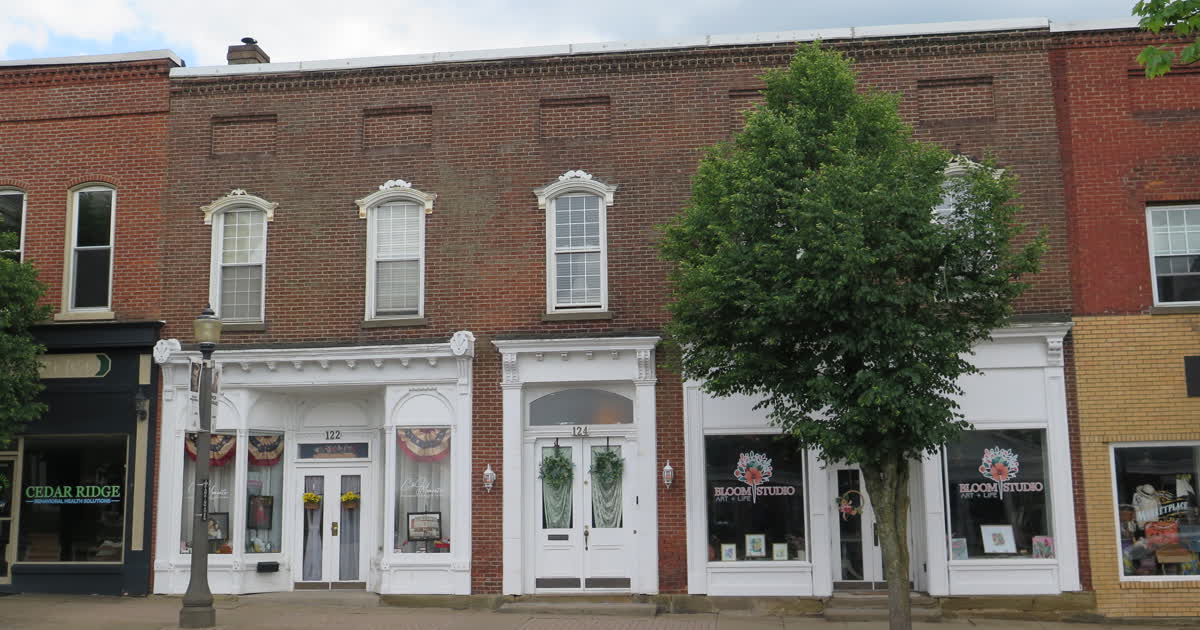
The St. Clairsville Historic District runs three blocks along Main Street, just under 20 acres, and the nomination counts 64 contributing resources inside it. Benjamin Lundy made his home at 164 East Main from 1815 to 1819 and organized the Union Humane Society there, which the nomination calls the first anti-slavery society in the United States. The Clarendon Hotel has stood at Main and Market since 1889. One storefront on East Main is reported to be a log building from about 1830 under its Italianate front.
I own that log building, and the one next door, a narrow three-story house from about 1890 that most people here know as Home Pizza.
My family's stake in this town goes back three generations. The firm that carries my grandfather Harvey Goodman's name dates to 1957, and the apartments my family began building here in the 1960s are still occupied today. We are still building, with 16 new apartment homes under construction near St. Clairsville and scheduled to open in 2027.

Why Good Historic Buildings Sit Empty
I have written before about buying the Adams House while Home Pizza was still open, partly because my sister, who has lived away for more than 45 years, still wants that pizza the minute she gets home. My estimate to put the building back into full operating condition runs upwards of $500,000. As I said on the radio this month, I will eat the pizza. I do not want to run the shop.
That $500,000 figure is the central problem in a small town, and my business has a name for it: the feasibility gap. The cost to rehabilitate an old building properly is often more than the finished building can earn back in rent. Heritage Ohio's 2025 annual report puts the average rent in Ohio's Main Street districts at $11.51 per square foot and the downtown vacancy rate at 14.67 percent. At that rent, a 2,500-square-foot storefront grosses under $29,000 a year before taxes, insurance and maintenance. A lender will not underwrite a half-million-dollar rehabilitation against that income, so an owner who can't close the gap waits.
Waiting is expensive. As a property-management expert witness in premises-safety cases, I have seen what deferred building problems cost owners in repairs and in liability. When every owner on a block is waiting, the street looks tired, rents soften, and the gap widens for all of us. St. Clairsville has about 5,100 residents. Towns our size rarely have preservation staff or a development department to break that cycle.
What Heritage Ohio Does
Heritage Ohio began in 1989 as Downtown Ohio, Inc. and describes itself as Ohio's official historic preservation and Main Street organization. For a town like ours, its work comes down to five jobs.
It tells the story. The 250 Buildings, 250 Stories initiative, timed to the nation's 250th anniversary, "identifies, tells the story of, and catalyzes reinvestment in 250 historic buildings." Heritage Ohio featured Home Pizza on November 18. Within five days the post had more than 200 reactions and about 100 shares.

It assesses and teaches. A Downtown Assessment Resource Team visit brings revitalization practitioners to tour a district, meet with stakeholders and deliver a written plan with specific recommendations. Preservation Assessment Workshops add an evening public lecture and one-on-one assessments of up to five downtown buildings.
It advocates. In 2025 the Ohio Historic Preservation Tax Credit was at risk of being eliminated in the state budget. Heritage Ohio's trustees testified, and the annual report lists the result: annual funding raised to $75 million, the sunset provision removed, and the credit for communities under 300,000 people increased to 35 percent of qualified rehabilitation expenditures.
It lends. Save Ohio's Treasures is a revolving fund that offers below-market loans for renovations, code compliance, emergency repairs and stabilization of historic commercial properties. That can keep a building in service until a full rehabilitation is possible.
It runs Main Street. Heritage Ohio has coordinated the Ohio Main Street Program since 2002. In 2025, Ohio's Main Street communities reported 147 net new businesses, 254 net new full-time jobs, 387 facade improvements and $78.4 million in private rehabilitation investment.
How Tax Credits Change the Math
Historic tax credits are where the feasibility gap starts to close. The federal credit is 20 percent of qualified costs on a certified historic building in income-producing use. Ohio's credit is competitive, and in a municipality of fewer than 300,000 residents an applicant may request up to 35 percent.
Those figures are ceilings, not promises. The Ohio Department of Development awards the state credit, the National Park Service certifies the federal one, and single-family homes don't qualify. Heritage Ohio awards neither one. It defends the programs and teaches owners how to use them. Any owner considering this needs a tax adviser and a preservation consultant at the table. Contributing to a National Register district like ours meets one threshold for the Ohio credit, but listing only opens the door. Every project still has to qualify and compete.
We already have proof on our own Main Street. The state's program report lists the Clarendon Hotel as a $3.6 million rehabilitation supported by a $750,000 Ohio credit. Its developer, Steve Coon, told The Repository, "Without those credits, I wouldn't have restored any of these buildings."
It has not happened here often enough. The state's Round 37 application guide lists $899,496 in approved credits for all of Belmont County, which works out to $13.53 per resident. Cuyahoga County's figure is $360.86. The scoring now leans toward places like ours: on the county-balance measure Belmont earns 6 of 7 possible points and Cuyahoga earns 2. Applications for the next round are due March 31, 2027.
Barnesville Went First
The nearest example is in my own county. Barnesville hosted a two-day assessment visit in November 2025. More than 40 officials, owners and residents came to the evening workshop, Barnesville Area News reported. The $5,000 cost was covered by a Heritage Ohio matching grant along with contributions from the village, its chamber of commerce and the Belmont County Tourism Council. Heritage Ohio's annual report lists Barnesville among four new Aspiring Main Street communities for 2025.
St. Clairsville, the county seat, is not on that list. A community completes the assessment and is enrolled as an Aspiring Main Street community for one year. After that, Aspiring membership is $2,250 a year. From there a town builds its local organization around the program's Four Points (Organization, Design, Promotions and Economic Development) and works toward national accreditation.
Set against a single $500,000 rehabilitation, a $5,000 assessment is one percent of the cost.
One Night on Main Street
Light Up Night, hosted by the City and the St. Clairsville Area Chamber of Commerce, ran from 4 to 8 p.m. on November 21. WTRF reported that thousands gathered just outside the county courthouse for a skating rink, live performances and more than 30 craft and food vendors. At 7 p.m. Santa lit the community tree, WTOV reported.
The Chamber's executive director told WTOV that the first year the town held an event like this, a little girl came up to her and asked, "Can I come back tomorrow?" The mayor told WTRF, "I could not be more proud of my town."
The tree and Santa were the occasion. The buildings were the setting: brick fronts, arched windows, the courthouse steps and lamp posts hung with wreaths. That setting came with two centuries on the National Road, and no town can order one like it.
That little girl asked the right question. Heritage Ohio's Main Street approach calls what we saw Promotions, one of its Four Points. Bringing people back tomorrow, and the day after that, takes the other three points, and it takes storefronts with the lights on every evening.
We would not be starting from nothing. A Main Street small-business group had grown to 21 member businesses by 2025 and hosts events downtown almost every month. What we are missing is the organizing framework and the financing know-how that turn a good Saturday night into a rehabilitated block.
Where Things Stand
I have submitted stories to 250 Buildings, 250 Stories for several buildings in town, including the Adams House and the log building beside it. Those are submissions. Heritage Ohio decides what it features. I joined Heritage Ohio as an individual member, and I have asked the State Historic Preservation Office for an information meeting in January about my two Main Street buildings. I have not applied for a tax credit, and no one has promised me one.
I also want St. Clairsville in the Ohio Main Street Program, beginning with an assessment visit, and I am prepared to help fund that privately if it gets us there sooner. That is my own goal. I am not speaking for the City or for any local organization, and none of them has committed to anything. Barnesville did this as a coalition, and I think that is the right model for us.
To downtown owners: tell your building's story, and come learn how the credits work before you decide the numbers can't work. To my neighbors: if we can bring an assessment team to town, fill the room the way Barnesville did.
The National Road brought the country through this town 200 years ago. The buildings from those years are still standing on Main Street, and I would like them to be earning their keep when the next generation of my family walks it.
Emily Goodman Shortall, CPM®, ARM®, is Co-Owner and Developer of Goodman Properties in St. Clairsville, Ohio, a third-generation real estate developer and owner-operator, and a property-management expert witness.
credit line) and four charts
Sources
- National Register registration form, St. Clairsville Historic District: https://stclairsville.com/wp-content/uploads/2018/03/NRHP-Registration.pdf
- Heritage Ohio: https://heritageohio.org/
- Heritage Ohio 2025 Annual Impact Report: https://heritageohio.org/wp-content/uploads/2026/03/2025-Annual-Report.pdf
- Radio interview, The Bloomdaddy Experience, November 23, 2026: https://www.iheart.com/podcast/1248-the-bloomdaddy-experience-99507127/episode/11-23-26-sam-otis-emily-shortall-goodman-propeties-potential-retun-of-home-pizza-in-st-clairsville-350630505/
- U.S. Census Bureau, St. Clairsville: https://data.census.gov/all?g=160XX00US3969526
- Heritage Ohio, 250 Buildings, 250 Stories: https://heritageohio.org/250-buildings-250-stories/
- Heritage Ohio Facebook post featuring Home Pizza: https://www.facebook.com/HeritageOhio/posts/1566276215535497
- Heritage Ohio, Downtown Assessment: https://heritageohio.org/downtown-assessment/
- Heritage Ohio, Preservation Assessment Workshop: https://heritageohio.org/preservation-assessment-workshop/
- Heritage Ohio, Save Ohio's Treasures: https://heritageohio.org/save-ohios-treasures/
- Heritage Ohio, Ohio Main Street Program: https://heritageohio.org/ohio-main-street-program/
- Heritage Ohio, Historic Tax Credits: https://heritageohio.org/historic-tax-credits/
- Ohio Department of Development, Ohio Historic Preservation Tax Credit Program: https://development.ohio.gov/community/redevelopment/ohio-historic-preservation-tax-credit-program
- Ohio Department of Development, 2015 OHPTC Comprehensive Report: https://dam.assets.ohio.gov/image/upload/development.ohio.gov/community/redevelopment/2015OHPTCComprehensiveReport.pdf
- The Repository, October 17, 2017: https://www.cantonrep.com/story/news/local/canton/2017/10/17/developer-steve-coon-gets-historic/18279838007/
- Ohio Department of Development, Round 37 Application Guide: https://dam.assets.ohio.gov/image/upload/development.ohio.gov/community/redevelopment/OHPTC_Application_Guide_-_Round_37.docx.pdf
- Barnesville Area News, November 22, 2025: https://barnesvillenews.org/2025/11/22/meeting-introduces-main-street-program/
- Heritage Ohio, Getting Started: https://heritageohio.org/ohio-main-street-program/getting-started/
- Heritage Ohio, Aspiring Main Street Program: https://heritageohio.org/ohio-main-street-program/aspiring-main-street-program/
- WTRF, Light Up Night: https://www.wtrf.com/top-stories/santa-brings-christmas-magic-to-st-clairsville-for-light-up-night-thousands-pack-main-street-for-the-celebration/
- WTOV, Light Up Night: https://wtov9.com/news/local/santa-lights-st-clairsville-christmas-tree-at-packed-light-up-night-on-main-street
- WTOV, St. Clairsville Main Street small-business growth: https://wtov9.com/news/local/st-clairsvilles-main-street-thrives-with-small-business-growth-st-clairsville-main-street-small-business-growth-cedar-one-realty-community-events-historic-district
- Heritage Ohio, Membership: https://heritageohio.org/join-now/
Photo: Main Street storefronts in St. Clairsville, via Wikimedia Commons (CC0).