


A decades‑old idea revived

The I‑73 concept is not new: regional planners and business coalitions have floated versions of a north–south interstate tying the Great Lakes to the Southeast since the 1990s, but Ohio’s segment repeatedly stalled as other priorities captured limited highway dollars. What is different now is the convergence of two forces—renewed federal emphasis on “strategic corridors” and a patchwork of new industrial and defense‑related projects in southern and central Ohio—that has given the project fresh political momentum. State officials have already authorized and funded a feasibility study, positioning Ohio to move quickly if federal money materializes.
Taylor’s letter and the bipartisan front

Taylor, a Republican whose district stretches across much of southern Ohio, has emerged as the project’s most visible champion in Washington. He previously introduced a House resolution supporting an I‑73 corridor and, more recently, led a bipartisan, bicameral letter from members of Ohio’s delegation urging the U.S. Department of Transportation to back a full feasibility study for the Toledo‑to‑Chesapeake route. The letter, addressed to Transportation Secretary Sean Duffy, casts the corridor as a rare cross‑party priority that could “bridge the gap between rural and urban communities” and modernize a region long left behind by interstate‑driven growth.
The proposed route and its promises

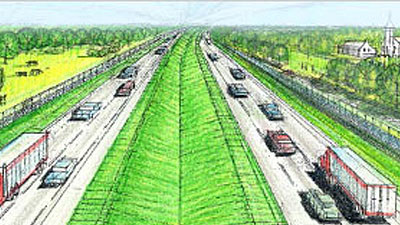
Under current concepts, the Ohio leg of I‑73 would largely trace U.S. Route 23, starting near Toledo at the Michigan border, cutting through the Columbus region, and continuing south toward Chesapeake at the junction of Ohio, Kentucky, and West Virginia. State transportation documents and Taylor’s own resolution describe a roughly 270‑mile corridor designed to relieve chronic congestion, improve freight flows, and give rural counties the kind of interstate access that has historically steered major employers elsewhere. Supporters say the project could finally connect Appalachian main streets to the “modern economy,” making it easier for workers to reach new factories and for locally produced goods to reach national markets.
Economic stakes: boosters vs. skeptics

Taylor and allied lawmakers argue that I‑73 would amplify a wave of recent investment in southern and central Ohio, pointing to a major defense‑technology manufacturing facility near Columbus and a growing uranium enrichment site in Piketon, among other projects. In their telling, the corridor is as much about national security and supply‑chain resilience as it is about rural development, offering faster, more redundant routes for military‑linked cargo and critical materials. But critics warn that the projected price tag—some analyses have floated multibillion‑dollar estimates for the broader I‑73 network—threatens to drain resources from repairing existing roads and bridges, which already receive poor condition grades in parts of Ohio.
Inside the feasibility study
The feasibility study at the heart of Taylor’s push is modest on paper—about a $1.5 million effort for Ohio’s segment—but sweeping in scope. Plans call for capacity and safety analyses, detailed access management, environmental and community impact reviews, and full economic and cost‑benefit modeling, with a final report expected by the end of 2026. State officials stress that the study alone does not commit Ohio to build I‑73; instead, they say it is meant to “arm decision makers with data,” a phrase that has become a talking point for both supporters seeking momentum and opponents hoping to slow the project at the analytic stage.
Southern Ohio’s long wait for a highway
To understand why Taylor has found a receptive audience at home, it helps to look at a region that has watched other parts of the state prosper along existing interstates. Southern Ohio’s Appalachian counties, many of them in Taylor’s district, lag behind on income, employment, and population growth, with limited four‑lane access often cited by local officials as a structural handicap. Economic development professionals in the area say major manufacturers frequently bypass communities that sit miles from interstate interchanges, regardless of available land or labor, because logistics costs and travel times are harder to predict. For them, I‑73 represents not just pavement but leverage in recruiting projects that routinely gravitate to better‑connected regions.
Environmental and community concerns
The prospect of carving a high‑speed corridor along and beyond U.S. 23 has also stirred anxiety in towns and rural townships that would sit in I‑73’s path. Environmental groups and some local residents worry about habitat fragmentation, air and noise pollution, and the potential for new interchanges to fuel sprawl at the expense of farms and forests. Others warn that interstates can bypass the very main streets they are meant to save, pulling commerce toward distant exits lined with national chains rather than locally owned businesses. The feasibility study’s environmental and community impact components are likely to become flashpoints as route alternatives are mapped and trade‑offs documented.
The politics of a “strategic corridor”
Nationally, the proposed I‑73 aligns with a broader push to designate and fund “critical freight” and “strategic” corridors that promise both economic and security benefits. Proponents within Ohio link the highway to a multistate I‑73‑74‑75 vision, promoting a nearly 1,000‑mile spine from Michigan’s Upper Peninsula to South Carolina’s coast that could serve as a hurricane evacuation route and industrial super‑corridor. Yet Ohio’s buy‑in, and Taylor’s advocacy in particular, also reflects a political calculus: attaching southern Ohio’s needs to a larger, defense‑tinged narrative may increase the odds of winning scarce federal funds in a crowded infrastructure agenda.
What happens next
For now, Taylor’s bipartisan letter is an opening move in a longer campaign that will run through statehouse committees, federal appropriations fights, and years of technical analysis. If the feasibility study delivers a strong economic case, Ohio lawmakers will still need to decide whether to back a megaproject that could reshape travel patterns and budgets for decades. And communities from Toledo to Chesapeake will have to confront an uncomfortable question: whether the promise of growth and connectivity outweighs the risks of cost overruns, disruption, and the possibility that, once again, the benefits of a major highway may flow past them rather than through their doors.