


Quick Takeaways
- A one-week joint truck enforcement sweep in Warren County in October 2026 stopped 561 trucks, issued 423 citations and took 73 vehicles off the road, The Cincinnati Enquirer reported.
- Hamilton Township trustees have directed $100,000 in the 2027 budget toward stepped-up truck traffic enforcement, and township leaders say the effort will continue.
- State lawmakers heard House Bill 753, on English-language driver testing, in committee on November 17, 2026, while the Ohio Bureau of Motor Vehicles moves to downgrade about 5,000 nondomiciled commercial licenses.
MAINEVILLE, Ohio — A surge of semi-truck traffic through Hamilton Township in Warren County has grown into one of Ohio’s sharpest local debates, drawing a week-long enforcement sweep, $100,000 in new township funding and two bills at the Statehouse, The Cincinnati Enquirer reported.
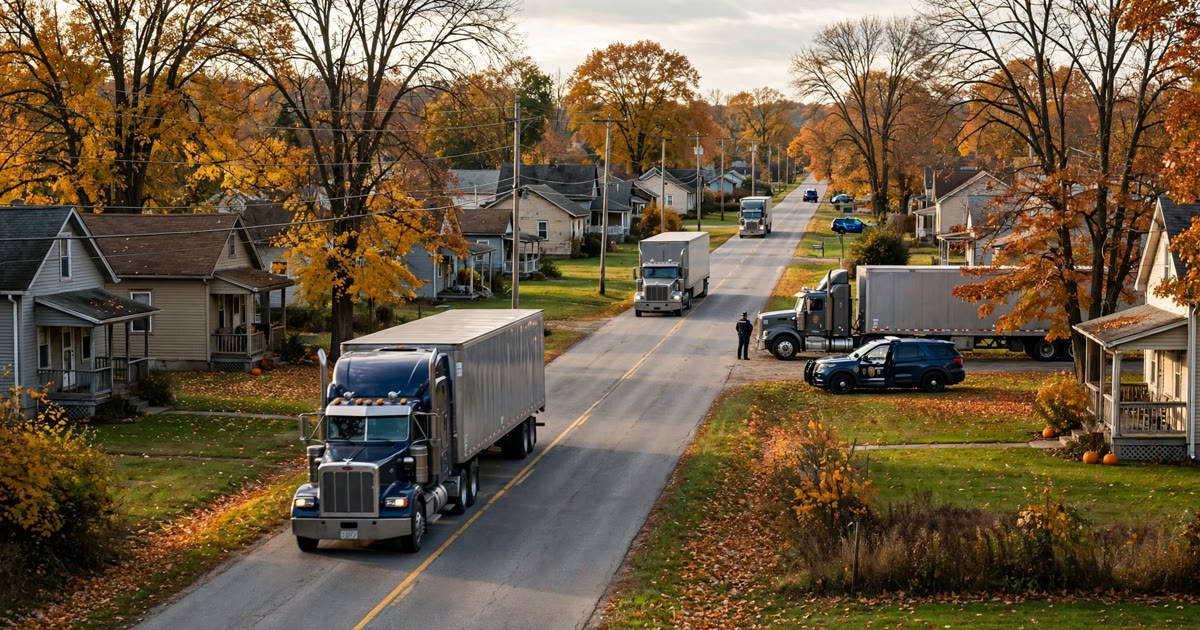
The change arrived about five years ago, when a commercial truck parking facility opened in the village of Maineville, about 30 miles northeast of Cincinnati. Police Chief Quillan Short told The Cincinnati Enquirer the community of about 32,000 was caught off guard: the township’s narrow, two-lane roads were not built for heavy trucks, and neighbors complained that braking noise kept them awake.
Township officials responded with new rules restricting where truck drivers could park, but complaints continued. The township moved into the national spotlight after an Uzbek truck driver from Maineville was involved in a crash that killed 21-year-old Tobias Forsythe, The Cincinnati Enquirer reported. Anonymous social media accounts then drew attention to the area’s growing Uzbek community and its ties to trucking, and state lawmakers joined the debate.
At a November 4, 2026, Hamilton Township trustees meeting, some speakers blamed immigrant neighbors for the truck traffic and objected to a mosque under construction in Maineville, The Cincinnati Enquirer reported. Members of the Uzbek community told The Cincinnati Enquirer that broad generalizations about thousands of local families are harmful, and that the national attention has left some residents feeling unsafe.
Sukhrob Norbekov, a foreign legal consultant who works with Uzbek clients in Greater Cincinnati, told The Cincinnati Enquirer that Uzbek families, businesses and community leaders “are not hiding from anyone” and want to work with neighbors and local officials. “If someone is not doing a good thing, I think the government and law enforcement is already taking care of them,” Norbekov told The Cincinnati Enquirer. “But we shouldn’t say that all Uzbeks are bad people and all the Uzbek trucking companies are doing unlawful things.”
Chief Short, who took over the 29-member department in May 2026, frames the response as an industry safety effort. In one week in October 2026, his department worked with the Warren County Sheriff’s Office, the Lebanon Police Department and the Ohio State Highway Patrol, stopping 561 trucks and issuing 423 citations, The Cincinnati Enquirer reported. Seventy-three vehicles that failed inspections were removed from the roads, and 36 people were arrested, including 31 drivers for immigration-related causes.
“This isn’t an immigration issue,” Short told The Cincinnati Enquirer. “We’re tackling an industry that is operating unsafe in Warren County. And are some of them immigrants? Absolutely, some of them are. Are some of them not? Sure, we stopped other ones that aren’t, as well.”
The enforcement will continue, and it now has dedicated money behind it. Township Administrator Jeff Wright told The Cincinnati Enquirer that the township’s three elected trustees directed him to allocate $100,000 in 2027 to fund the police department’s increased traffic safety work. Wright told The Cincinnati Enquirer he hopes the state funds more targeted enforcement and thinks the township could become a “test case” for others across Ohio, adding, “When you’re talking about semi traffic, it’s actually everybody’s concern or everybody’s problem in Ohio.”
At the Statehouse, Representative Michelle Teska, whose district includes Maineville, announced in October 2026 that she is pushing legislation on English proficiency and improperly licensed drivers, The Cincinnati Enquirer reported. Representative Jean Schmidt of Loveland has introduced House Bill 753, which would require driver’s tests to be administered in English; the Ohio House Transportation Committee heard the bill on November 17, 2026, according to The Cincinnati Enquirer.
The Ohio Bureau of Motor Vehicles (BMV) announced in October 2026 that it will end its commercial driver’s license (CDL) program for nonpermanent legal residents and downgrade licenses for about 3,000 immigrants, with about 5,000 nondomiciled CDL holders affected statewide out of 406,000 CDL holders in Ohio, The Cincinnati Enquirer reported. Thomas Balzer, president and chief executive officer of the Ohio Trucking Association, told The Cincinnati Enquirer that neither the BMV nor the Highway Patrol tracks crashes among nondomiciled CDL holders, and warned that fewer available drivers means more expensive freight.

What happens next runs on two tracks. In Warren County, the targeted truck enforcement continues with the new 2027 funding. In Columbus, House Bill 753 and Representative Teska’s proposal move through the committee process, where lawmakers will decide how much of the township’s experience becomes statewide law.