


Quick Takeaways
• Enrollment at The Electrical Trades Center of Central Ohio has grown from 500 apprentices in 2022 to more than 800 today, driven in part by the data center construction boom around Columbus.
• A growing share of the new apprentices are college graduates, including a 36-year-old former social worker who says she already earns more as an apprentice than she did in social work.
• Apprentices start at $23 an hour and can reach $46 an hour, with many journeyworker electricians earning more than $100,000 a year with overtime, according to the center.
COLUMBUS, Ohio — Ashley Baukman spent years in college classrooms and then in local government offices, working with children and seniors as a social worker. Now the 36-year-old is spending her days on construction sites and in a training classroom south of The Ohio State University, bending steel conduit as an electrician apprentice — and she told NPR she is already earning more than she did in social work.
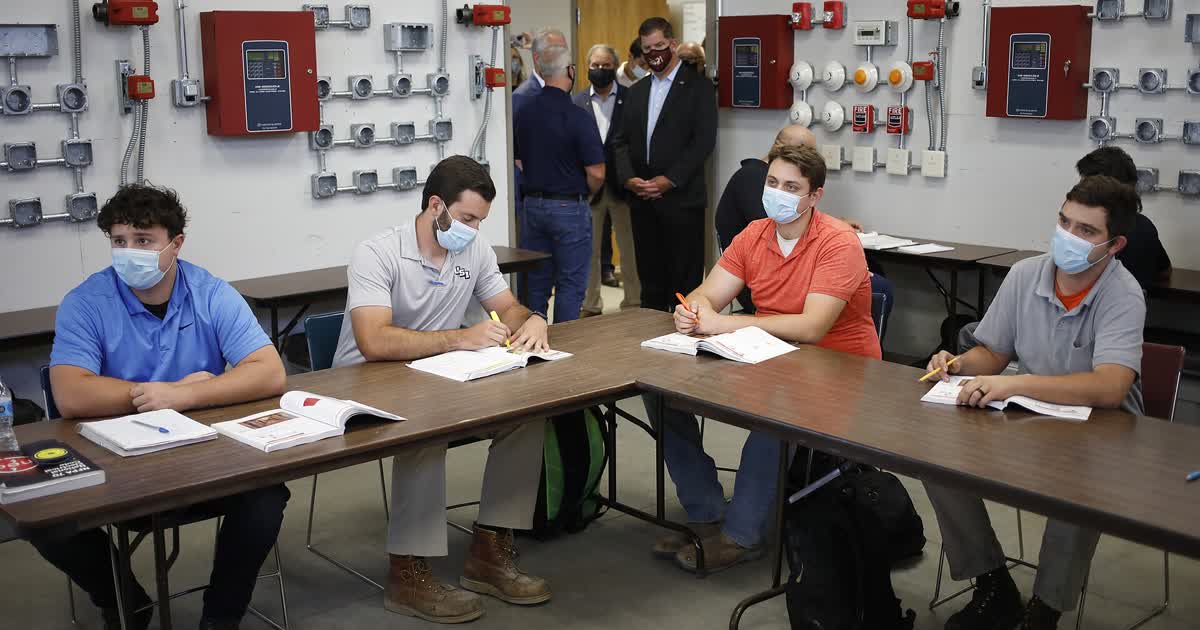
Baukman began the apprenticeship at The Electrical Trades Center of Central Ohio in the spring, NPR reported on November 17, 2026. She attends class one day out of every two weeks and spends the rest of her time working on construction sites under the supervision of journeyman electricians. She is paid just over $25 an hour for time on the job and receives a stipend for classroom days, according to NPR.
Baukman was the first in her family to graduate from college. After finishing her social work degree, she worked in local government agencies with children and seniors but never earned enough to support her blended family, she told NPR. The school social worker role she wanted would have required a master’s degree she could not afford while raising five children at home and carrying an estimated $80,000 in student loans.
“It just wasn’t in the cards,” she told NPR. “So I was looking for a change.”
Baukman is not alone in trading a degree for a trade. Trent Parker, the director of The Electrical Trades Center and an electrician himself, told NPR that several dozen of the apprentices currently enrolled hold four-year degrees, and roughly 300 applicants have at least some college on their resumes.
“The word is out that college is not the only way to go, that there are other alternatives that can provide a living wage with benefits,” Parker told NPR.
The center’s growth has been rapid. Enrollment has grown from 500 apprentices in 2022 to more than 800 today, according to Parker, and the school has moved from evening-only instruction to daytime classes to handle the growth. The construction boom fueled by data centers has contributed to the expansion, NPR reported, and the center is funded through the collective bargaining agreement between the Central Ohio Chapter of the National Electrical Contractors Association and the International Brotherhood of Electrical Workers Local 683.
The training is demanding in its own right. Parker told NPR the curriculum is equivalent to college-level coursework: conduit bending is based on trigonometry, and apprentices must manipulate decimals and fractions.
“You know, we’re looking for high performers,” Parker told NPR. “The same people that are going to be successful in college are the same people that are going to be successful here.”
The other college graduates in the program told NPR similar stories of careers that did not pay enough. Mike Hansen, 39, entered the apprenticeship after college, ten years in the Army and some graduate school, leaving a doctoral track after seeing academics work 40 hours of teaching for $40,000 a year, he told NPR. Michael Hughes, an English major who once dreamed of writing for television, has since pulled wire, added pipe and replaced panels and fuses in a police station, a paper mill, a sheet metal plant and an auto plant, according to NPR.

The money is a large part of the draw. Apprentices are guaranteed a minimum hourly wage that starts at $23 an hour, with built-in raises as they reach milestones for hours worked, topping out at $46 an hour, NPR reported. With overtime, many journeyworker electricians earn well over $100,000 a year, according to NPR. Harry Cekovich, an Ohio State University graduate assigned to a solar field, told NPR the union contract gives him retirement benefits and health insurance with no premiums for the first time in his working life.
Data centers are also the part of the work the apprentices are most divided about. The rapid buildout — especially hyperscale facilities built to power artificial intelligence — accounts for about half the work in the school’s jurisdiction, NPR reported. Hansen told NPR he is concerned about the heavy energy and water use and the noise data centers generate and plans to avoid data center jobs once he can choose his own assignments as a journeyman.

The debate is now a live political question in Ohio. Governor-elect Amy Acton has called for a “conditional moratorium” on new data center construction, NPR reported. The tax break behind the boom is also under scrutiny: a study released this week found the state’s data center tax exemption cost Ohio schools $374 million in 2025, as NewsForce247 reported in its coverage of the new study.
What we know — and what we’re still waiting on: the center’s enrollment growth, wage scale and the college-graduate trend are confirmed by the center’s director, and the apprentices’ own accounts are on the record with NPR. What is not yet known is whether the pace of data center construction — and with it, demand for electricians — will hold if the governor-elect’s proposed conditions slow new projects.
What happens next: apprentices continue to be assigned based on contractor need, and the center’s daytime classes continue to expand with enrollment. Local rules for new data centers are also being weighed across Ohio, as NewsForce247 reported in its coverage of Findlay’s data center zoning debate.
Photo: US Department of Labor, CC BY