


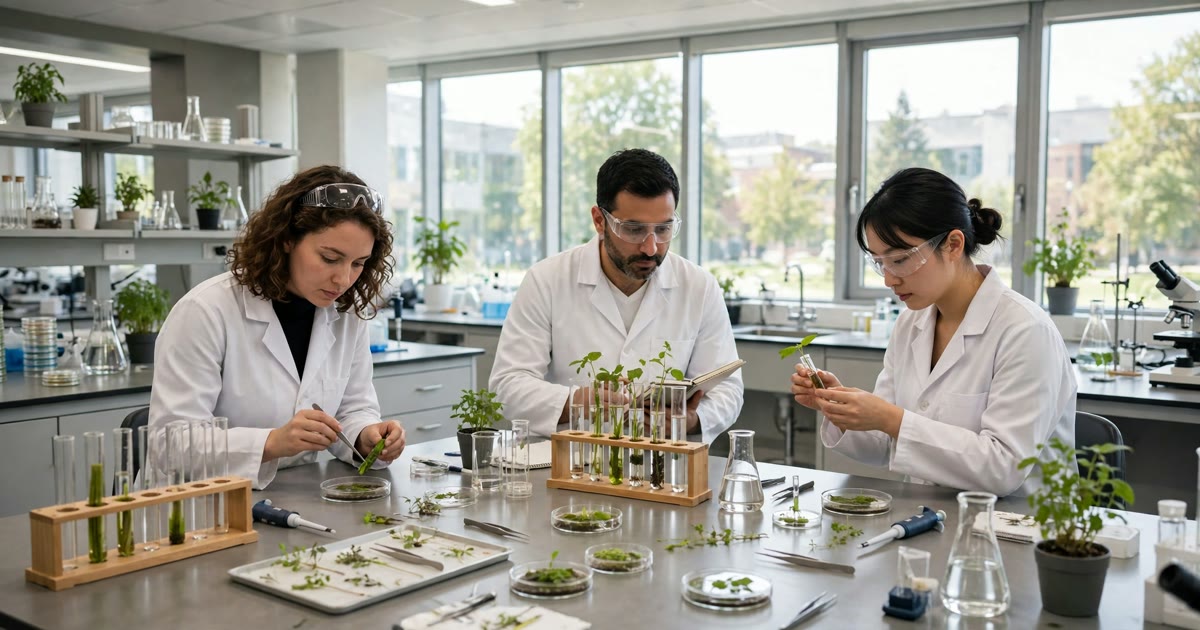
Central State University in Wilberforce has unveiled new laboratories for artificial intelligence and food safety research inside its $40 million Research and Demonstration Complex, WHIO reported — the latest piece of the 1890 land-grant university’s push to become a working research hub for Ohio agriculture. The 40,000-square-foot facility anchors a planned agricultural campus at Ohio’s only public historically Black university.
The complex houses several specialized labs under one roof, according to Central State: precision agriculture, food and safety, molecular biology and tissue culture, and soil and water research testing labs. A companion 24,000-square-foot farm operations and storage facility holds field equipment and offices for the research plots that feed those labs.
The food safety work has a head start. Central State’s food microbiology and plant pathology lab, led by food safety research assistant professor Robert Korir, has been working from leased space at Wright State University while the complex was completed, studying the microbiological quality of specialty crops, aquaponics production systems and the bacteria — Salmonella, E. coli, Listeria and others — that drive foodborne illness outbreaks. The new building brings that work home to Wilberforce.
The research agenda reaches well beyond one lab. University researchers work on pollinator health and honeybees, aquaculture production, water treatment technology and farm ergonomics safety, much of it funded by the U.S. Department of Agriculture and the state of Ohio in support of Central State’s land-grant mission. The entire complex project is funded by the USDA and the state, according to the university.
For Greene County and the surrounding farm country, the pitch is practical: an extension and research operation, minutes away, that tests crops, water and food safety questions for the small and mid-sized producers who make up most of Ohio agriculture — and trains students in the labs while it does it.
The complex is designed as the first structure in a larger agricultural campus, with room for corporate research partnerships and future buildings as programs grow. University leaders have described the investment as Central State claiming its place among the nation’s 1890 land-grant institutions.
What happens next: research teams move into the new labs as the complex fills out, and the university continues building out the surrounding farm campus in phases. For Ohio growers and food producers, the Wilberforce labs are now open for the kind of testing and partnership work that used to mean a trip to a larger campus.