


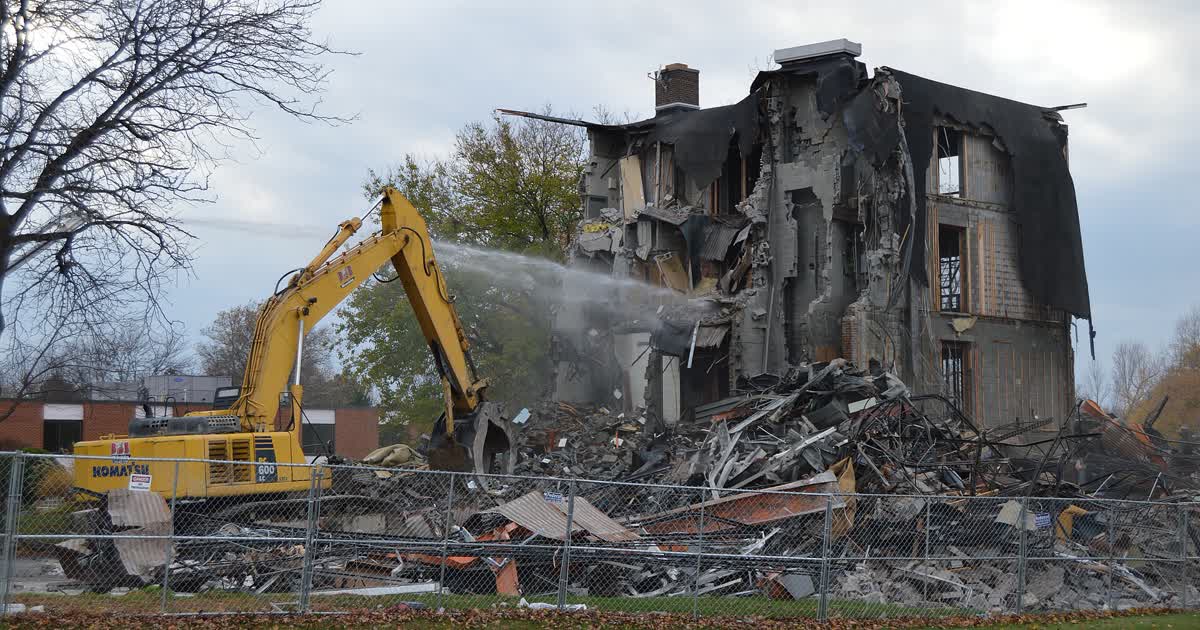
A century-old commercial building that sold Akron drivers some of their first automobiles is coming down on West Hill, as demolition crews raze the storefront and warehouse at 211 West Market Street, just west of St. Vincent-St. Mary High School. Ray Bertolini Trucking began tearing down the structure on Oct. 19, and within a day heavy machinery had reduced much of it to piles of smashed brick and twisted metal.
Crews kept a steady stream of water on the rubble to tamp down dust, and asbestos warning signs were posted around the cordoned-off work area. Demolition is expected to be completed by Oct. 23, but what comes next for the prominent West Market Street property has not yet been determined.

The building’s roots run deep in Akron’s automobile age. Summit County Fiscal Office records date it to 1923, while Beacon Journal records indicate 1928 was the correct year. Akron auto dealer Al Greenwald built the West Hill showroom for the Marmon Motor Co., a luxury automobile maker based in Indianapolis, on the former site of an eight-room home owned by Civil War veteran and former Summit County treasurer Emmons Oviatt and his wife, Mary.
The original dealership was built to impress: a 3,000-square-foot showroom with a terrazzo floor, a service department entered from Smith Street, and a used-car department on the second level. An orchestra provided entertainment at the grand opening in December 1928, when a new car showroom was still a neighborhood event worth dressing up for.

Greenwald operated the complex for about 15 years, switching to Plymouths and Dodges in the 1930s. Borden Automobiles, a distributor of DeSotos, took over in 1936, followed by Top Motors, a Hudson dealer, in 1949. In later decades the building cycled through other lives — residents remember buying television consoles, carpet, kitchen cabinets, office furniture and restaurant equipment there.
Many Akron drivers knew the building less for its tenants than for the big AKRON mural displayed on its side, a familiar marker along West Market Street. With the structure now falling, that piece of the streetscape is disappearing with it, leaving a cleared lot in a corridor where old commercial buildings have steadily given way.

For now the site is a demolition zone, not a development announcement. Residents watching the work this week are saying goodbye to a building their grandparents may have visited for a first car, while the future of the property — and whether anything rises in its place — remains an open question for West Hill.