


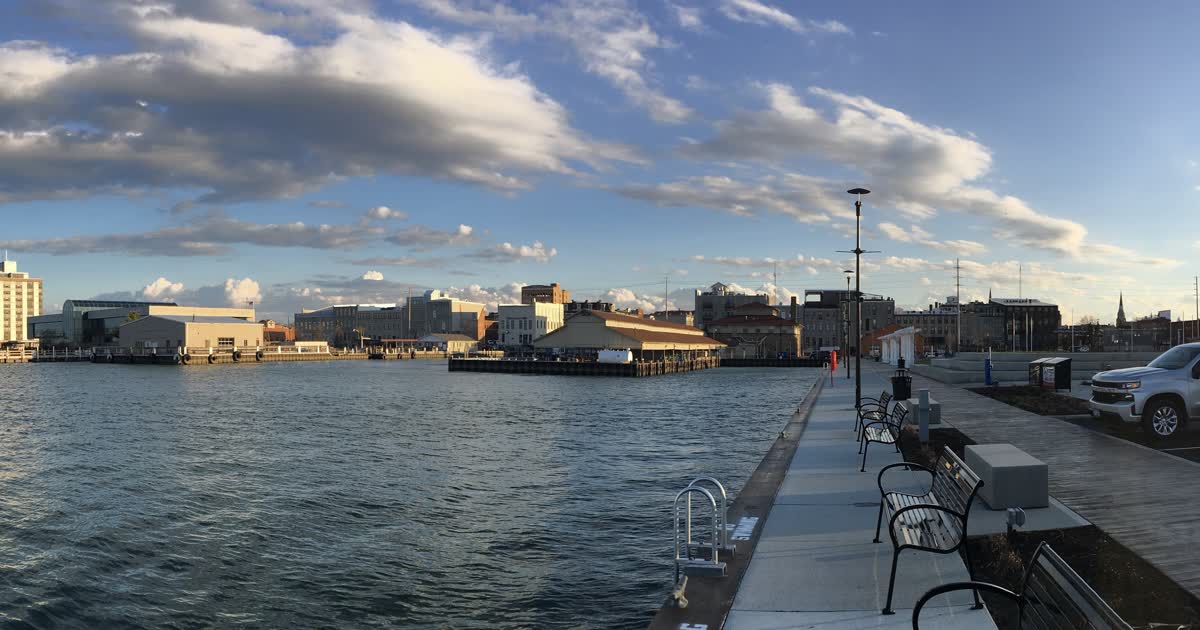
SANDUSKY, Ohio — The U.S. Army Corps of Engineers has finished this year’s dredging of Sandusky Harbor, removing about 109,000 cubic yards of sediment from the harbor’s two navigation channels and putting most of that sand to work restoring the Lake Erie shoreline, the Corps’ Buffalo District announced.
The work wrapped up on November 5 in the Moseley Channel and the Straight Channel, the two cuts that connect Sandusky Bay to the open lake. Crews had been on the water since October 6 under a $628,000 contract the Corps awarded in July to Morrish-Wallace Construction Co., a Michigan-based marine contractor, according to the U.S. Army Corps of Engineers release.

Where the sand went is the part of this year’s project that reaches beyond the shipping lanes. About 100,000 cubic yards of the dredged material was placed at a nearshore site, where Lake Erie’s natural currents are expected to carry it along the shore as beach nourishment. The remaining roughly 9,000 cubic yards went to a designated open-lake placement area, the Corps said.
“Completing dredging in Sandusky Harbor is another mark of the Corps of Engineers’ dedication to efficiency, good stewardship of American taxpayer dollars, and delivery of a critical mission the Corps of Engineers is known for,” Lt. Col. Aaron Anderson, commander of the Buffalo District, said in the U.S. Army Corps of Engineers release announcing the completion.

Sandusky Harbor is easy to mistake for scenery — the backdrop to Cedar Point’s skyline and the downtown waterfront — but it is a working deep-draft commercial harbor. Its federally authorized channel depths run from 21 to 26 feet, and those depths are what allow bulk carriers to reach the docks. When sediment settles and the channels shoal, ships must lighten their loads or stay away altogether.
The cargo numbers explain why the Corps returns. The harbor handled 2.6 million tons of cargo in 2023, and the Corps estimates waterborne transportation through Sandusky supports more than $322 million in annual economic impact, including $266.8 million in business revenue, 864 direct, indirect and induced jobs, and $55.5 million in labor income. Coal and lignite made up about 90 percent of the 2023 tonnage, with petroleum coke and coal coke accounting for most of the rest, according to the Corps release.

This year’s project was also notably larger than the last one. The harbor was previously dredged in 2025, when only about 9,000 cubic yards were removed — less than a twelfth of this fall’s total. The Corps notes that Sandusky Harbor dredging happens on an as-needed rhythm rather than a fixed calendar: the timing depends on how fast the channels shoal, on available funding, and on federal navigation priorities across the Great Lakes.
The beach-nourishment piece gives the project a second constituency beyond the shipping industry. Erie County’s Lake Erie shoreline loses sand to erosion year after year, and placing clean dredged material just offshore lets the lake redistribute it along beaches instead of dumping it as waste. Firelands Current and Dredging Today both carried the Corps’ completion announcement this week, underscoring regional interest in the nearshore placement.

Sandusky has had a busy civic stretch this month — Erie County is also choosing a path forward after Treasurer Stidham stepped down to seek an Ohio House seat, and voters across the bay in Sandusky County are electing a low-income representative to the GLCAP board this week. The harbor work, by contrast, is the quiet kind of government: a contract finished on schedule, announced in a release, and noticed mainly by the people whose livelihoods depend on the depth of the channel.
What happens next is a season of deeper water. With the channels restored to authorized depth, bulk traffic can move through the winter and into the spring shipping season without the draft restrictions that shoaling imposes. The Corps will survey the harbor again as part of its Great Lakes navigation program, and Sandusky will re-enter the queue for its next dredging cycle whenever shoaling, funding and federal priorities line up — as they have, on and off, for as long as the harbor has been a port.
For now, the cranes and hopper barges are gone from the Moseley and Straight channels, the sand is settling where the lake can use it, and one of Ohio’s oldest working harbors heads into winter at full depth.
Photo: Andre Carrotflower, CC BY-SA 4.0