


MEDINA, Ohio — If pieces of Tuesday morning’s fireball reached the ground, NASA scientists say they most likely fell in a narrow band across Medina County, stretching from the Hinckley and Richfield area southwest toward Rittman and parts of Wayne County, according to a NASA analysis reported by The Star Beacon.
The analysis, from NASA’s Astromaterials Research and Exploration Science office, maps the potential “strewn field” — the area where fragments of the exploding space rock were expected to land. Smaller fragments, pea-sized or less, were scattered most widely, from near Ohio 303 between Hinckley and Richfield south through the Hinckley Reservation, Granger Township and Sharon Center, ending near River Styx, according to the NASA model reported by The Star Beacon. Larger pieces, carried less by the wind, fell farther southwest.
The pattern reflects fierce winds high above the county — topping about 150 miles per hour roughly four and a half miles up — which pushed lighter debris northeast while heavier fragments dropped more directly, The Star Beacon reported. NASA cautions that the map is a simplified model and does not guarantee that larger meteorites reached the ground at all.
What we know — and what we’re still waiting on
What happened Tuesday is now well documented. The fireball appeared just before 9:00 AM, when a space rock about six feet across and weighing an estimated six metric tons entered the atmosphere over Lake Erie near Lorain, according to NASA. Traveling at roughly 40,000 miles per hour, it streaked about 34 miles southward before breaking apart over Medina County, releasing energy equivalent to about 250 tons of TNT and sending out the pressure wave that produced the boom heard and felt across Northeast Ohio.
The flash was picked up at 9:01 AM by a lightning-mapping instrument aboard a NOAA satellite, about 50 miles above Lake Erie, and the fireball was also detected by weather radar in Cleveland and Pittsburgh, The Star Beacon reported. Staff at the National Weather Service in Cleveland heard the boom and felt the vibrations themselves, and the American Meteor Society received sighting reports from as far away as Wisconsin and Maryland, the Willoughby News-Herald reported.
“This one really does look like it’s a fireball, which means it’s a meteorite — a small asteroid,” astronomer Carl Hergenrother, the American Meteor Society’s executive director, told the Willoughby News-Herald. He estimated the fireball may have been the size of a softball or basketball, or larger, moving at many tens of miles per second.
What is not yet known is whether anyone has actually found a piece of it. “There could be some small fragments, but a lot of it would have burned up in the atmosphere,” National Weather Service meteorologist Brian Mitchell told the Willoughby News-Herald. No confirmed fragment finds had been reported as of Tuesday.
For Medina and Wayne County residents, the NASA map is the practical takeaway: any genuine fragment would be a small, dark, unusually heavy rock, most plausibly found somewhere along that Hinckley-to-Rittman band. Scientists generally ask finders to photograph a suspected meteorite where it lies and avoid handling it with bare hands, so its surface stays intact for study.
What happens next is a waiting game. If fragments surface in the mapped field, researchers can confirm them in a lab and refine the rock’s path and makeup; if none do, Tuesday’s fireball will remain what it already is for most of Northeast Ohio — a nine-second morning sky show, a house-shaking boom, and the region’s most talked-about commute of the year.
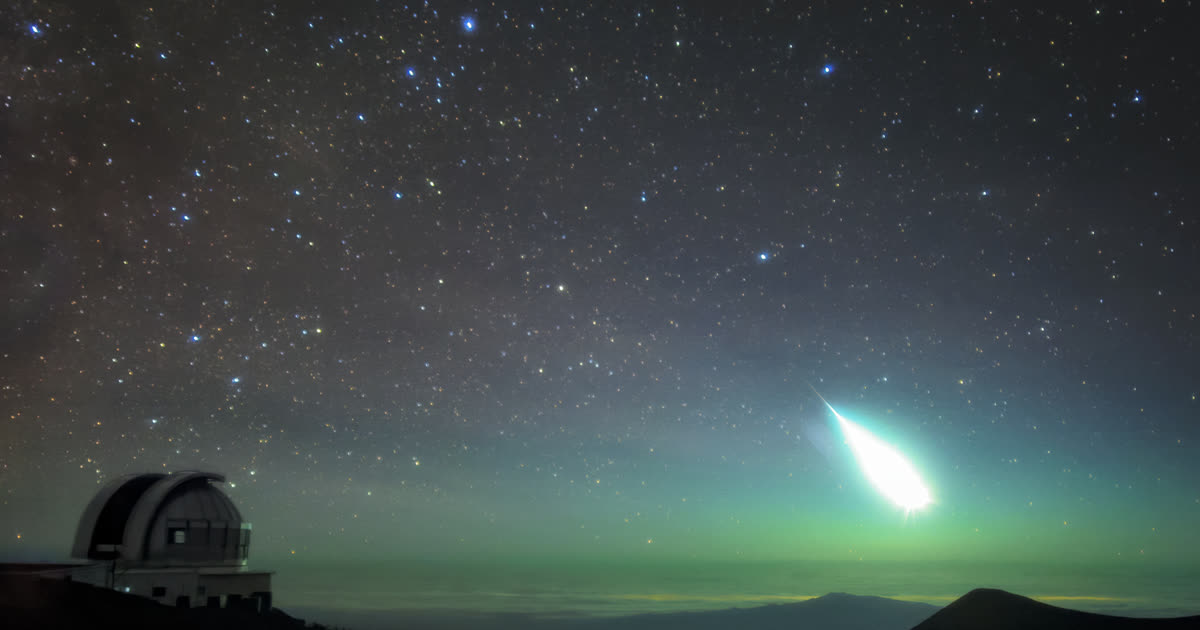
Photo: A bright fireball streaks across a starry sky in this file photo. Photo: International Gemini Observatory/NOIRLab/NSF/AURA, CC BY