


Ohio is taking its in-school vision program statewide in reach, expanding OhioSEE — the Ohio Student Eye Exam program — with more than $18 million in federal Rural Health Transformation funding alongside state money, in reporting by NBC4 in Columbus. The expansion extends comprehensive eye exams and prescription glasses, delivered inside schools at no cost to families, to students in kindergarten through grade 12 across 73 eligible counties, while the original state-funded part of the program keeps its focus on kindergarten through third grade.
OhioSEE grew out of a stubborn gap in children’s health care. State law requires schools to screen students’ vision, but it does not require follow-up care when a child fails — and the follow-up is where the system breaks down. According to Ohio Department of Health data cited in the reporting, only about 26 percent of Ohio kindergarten through third-grade students who fail an initial school vision screening ever receive a comprehensive follow-up eye examination.
The program was built to close that gap by bringing the exam to the child. OhioSEE launched as a pilot in 15 high-need counties — including Franklin, Cuyahoga, Butler, Montgomery and Lorain — where state data showed more than 80 percent of children identified through screenings as needing more vision care never received it. Governor Mike DeWine announced the program in February 2026 at Northeastern Elementary School in Clark County, saying the state picked the counties with the highest incidence of children not getting glasses and hoped to expand it to every county in Ohio.
In its first year, the program provided comprehensive eye exams to about 1,900 children and free eyeglasses to roughly 1,200 students, according to Prevent Blindness, whose National Center for Children’s Vision and Eye Health named DeWine its 2026 Bonnie Strickland Champion for Children’s Vision Award recipient for creating and expanding OhioSEE.

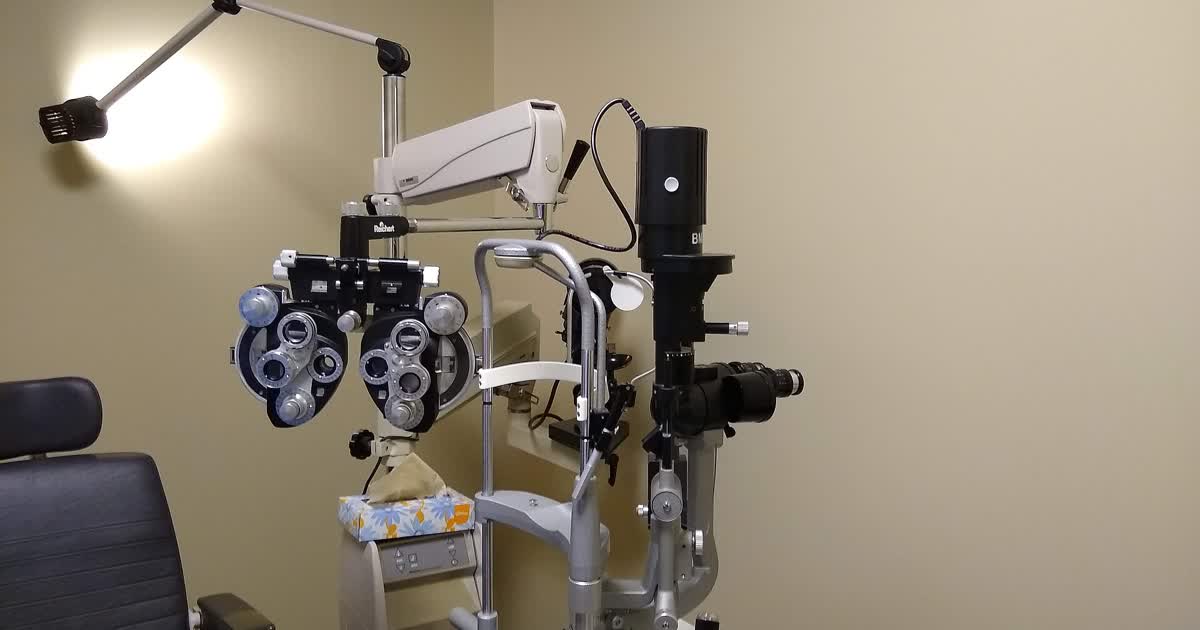
The mechanics are designed around how schools actually run. Through partner providers such as iSEE Ohio, eye care teams bring diagnostic instruments into participating schools, turning classrooms or libraries into temporary clinical spaces. Optometrists perform full evaluations, including pupil dilation. Dr. Mike Earley, an optometrist and board president-elect of iSEE Ohio, told NBC4 that about 80-some percent of the children examined after a failed screening actually need corrective lenses. Students who need glasses pick out their own frames, and staff return later to fit the finished glasses.
The need is not in doubt. In the 2022-23 school year, more than 93,000 Ohio students were referred for follow-up exams after screenings but only about 17,000 received them, according to state health department data reported by The Columbus Dispatch, and at least 35,000 students who needed glasses did not get them. A child who cannot see the board clearly is a child working against a solvable problem every school day.

There are limits families should understand. A school must formally enroll in OhioSEE for its students to take part, and parents or guardians must submit signed consent forms before a child is examined. The expanded coverage reaches 73 eligible counties rather than all 88 on day one, and the state-funded portion continues to concentrate on the youngest students, in kindergarten through third grade.
Steve Dorman, chief operating officer of iSEE Ohio, told NBC4 the organization works to connect students with local eye care professionals so families have stable, long-term care in their own neighborhoods — the school visit is meant to be a doorway into regular care, not a one-time fix.
What we know — and what we’re still waiting on
We know the expansion is funded, that it broadens the program from 15 pilot counties to K-12 coverage across 73 eligible counties, and that schools enroll and parents consent before exams happen. What is not yet public is the full county-by-county rollout schedule — which districts get visits first, and how quickly the remaining counties join. Those details will come from the Ohio Department of Health and participating districts as enrollment proceeds.
What happens next is enrollment: districts in the newly eligible counties, including Fairfield and Licking counties, can sign on, and families will receive consent information through their schools. For a program that began with a van visiting elementary schools, the statewide expansion is the moment OhioSEE either proves it can work at scale — or shows where the model strains. The children who failed a screening and never got glasses are the measure either way.
Photo: Wikijames1, CC BY-SA