


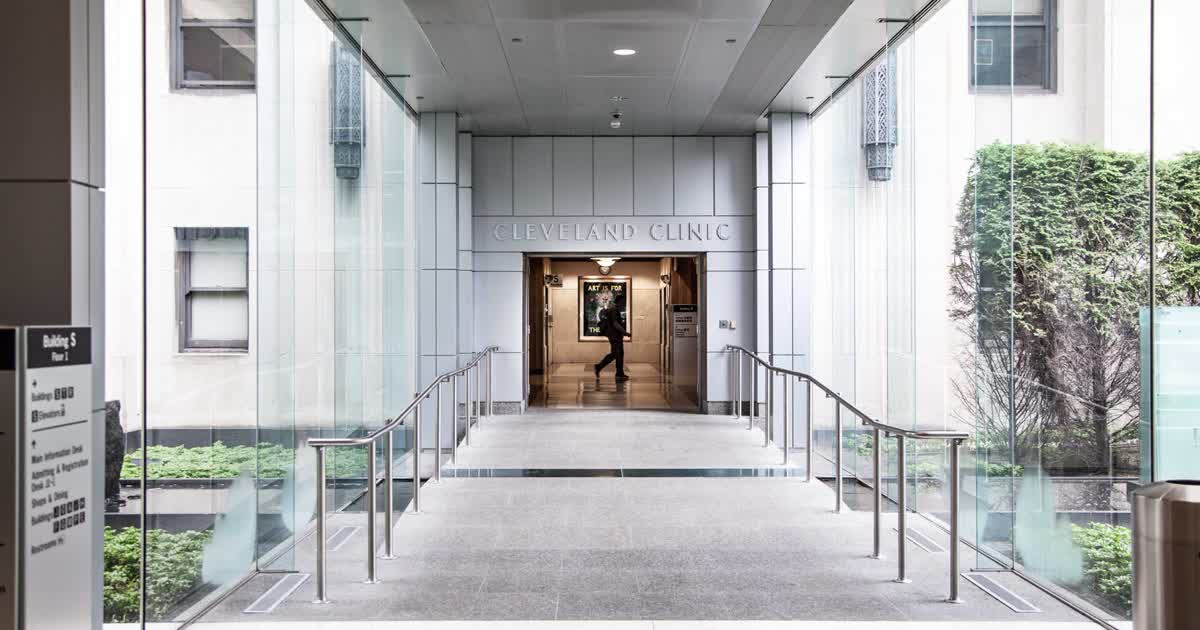
The Cleveland Clinic has asked the city for permission to demolish its Mellen Center — the Edward J. and Louise E. Mellen Center for Multiple Sclerosis Treatment and Research — including a brick, Euclid Avenue-facing section built in 1935 that is among the oldest buildings still standing on the Clinic’s Main Campus, according to NEOtrans, which reviewed the demolition application filed this week.
The 96,556-square-foot complex at 1950 E. 89th St. in Cleveland’s Hough neighborhood is known inside the Clinic as the U Building. It is actually four conjoined buildings added over the decades, and it houses both the multiple sclerosis treatment and research programs and the headquarters of the Cleveland Clinic Police Department, NEOtrans reported. Demolition is not expected until early 2027, after both occupants move.
The MS programs — the building’s largest use — are due to relocate in early 2027 to the Clinic’s Neurological Institute, its largest building ever: a $1.1 billion, 1-million-square-foot tower nearing completion one block south on Carnegie Avenue, according to NEOtrans. The police department will move next year to a former Rite Aid drug store at 10090 Chester Ave., an 11,870-square-foot building from 2007 on Clinic-owned land that closed in September 2024.
That police headquarters conversion will cost $4,526,100, according to a construction permit issued Nov. 9 to Mid-Continent Construction Co. of Bedford Heights — up from a $3.5 million estimate in July, NEOtrans reported. The demolition application was submitted the same day by DLR Group, the Cleveland architectural firm whose principal Hans Walter wrote in the application that the four conjoined buildings would be difficult to repurpose for clinical use because of their limited ceiling heights and planning arrangements, NEOtrans reported.

The surprise in the filing is what happens to the site first. “The near-term use of the site area will be for contractor parking, which is in high demand as building projects shift with the completion of the Neurological Institute,” Walter wrote in the permit application, quoted by NEOtrans. No cost estimate for the demolition itself was provided. Contractor parking is needed for two nearby projects: the $230 million expansion of the Clinic’s Emergency Department on Cedar Avenue and two large parking garages costing $175 million, according to NEOtrans.
The longer-term plan reaches further. After the Emergency Department expansion and the new garages are built, the Clinic anticipates relocating its aging Central Utility Plant — the East 90th Street plant marked by two tall smokestacks that provides emergency power to 3 million square feet of inpatient facilities — and the Mellen Center site is reportedly where officials are considering building a modern replacement, NEOtrans reported. The Clinic has said in a recent news release that a new utility plant is in the works but has not said where it will be built.
The Mellen Center’s story reaches back to the Clinic’s early decades. Its oldest component, the roughly 13,000-square-foot Euclid Avenue structure that now fronts the police station, was built in 1935, and additions followed to the north over the decades, NEOtrans reported. Its demolition continues a week — and a year — of steady turnover on a Main Campus spread across Cleveland’s Fairfax, Hough and University Circle neighborhoods, where the Clinic is also razing six structures for the Emergency Department expansion.
The pace of investment in Northeast Ohio children’s and family health care extends beyond the Clinic’s campus. In Akron, Akron Children’s 45th Holiday Tree Festival is drawing crowds through Nov. 22, and at the state level, Ohio is putting $55 million behind rural children’s vision, dental and school-based health care.
What we know — and what we’re still waiting on
What we know: the demolition application has been filed, the MS programs and the police department have identified new homes, the police conversion permit has been issued at $4,526,100, and demolition is planned for early 2027, according to NEOtrans’ review of the city filings. What we are still waiting on: a demolition cost, a city decision timeline on the application, and any Clinic confirmation of the utility plant’s future location.
What happens next runs on the Neurological Institute’s clock. When the tower opens in early 2027, the Mellen Center empties, the wrecking crews follow, and one of the Main Campus’s oldest addresses becomes — first — a parking lot, and eventually, possibly, the power plant that keeps a growing campus running.
Photo: Mutaz Albar, CC BY