


AKRON — Demolition will begin soon on the derelict 1890s building at 198 Cuyahoga Street in Akron’s Cascade Valley, closing a 130-year run that took the three-arched brick storefront from a neighborhood grocery to a storefront church to a condemned hazard, the Akron Beacon Journal reported in a local history tracing the building’s life.
The building’s facade is collapsing, its milled wood is rotting, and vandals have smashed its windows and tagged its walls, the Beacon Journal reported. Akron officials condemned the 19th-century structure as a public hazard in 2023 and awarded a contract on October 19 to Butcher & Son Excavating to tear it down.
The story begins with Fred Ewald, a German immigrant who came to Akron to work at the Cascade Mills and married Otillie Schumacher, a niece of Ferdinand Schumacher, in 1881, according to the Beacon Journal’s history. The couple opened Ewald’s Grocery in their home at the corner of Otto Street, a short walk from the Ohio & Erie Canal, and by March 1898 the Beacon Journal was reporting that Ewald was preparing to erect a new grocery store on Cuyahoga Street.
The new two-story, 2,750-square-foot building at Mustill and Cuyahoga streets became far more than a store. Its first floor held wooden shelves and glass cases of produce, meats, baked goods and household items, and the store doubled as the neighborhood’s gathering place — Ewald, naturalized as a citizen in 1888, hosted Republican and Democratic meetings and political rallies around the big stove in the rear, the Beacon Journal reported. Future Akron mayors William T. Sawyer, Frank W. Rockwell and I.S. Myers were among those who spoke there.

As chairman of the Cuyahoga Street Citizens Committee, Ewald successfully lobbied for the road to be paved with bricks from Howard Street to Tallmadge Avenue. In 1912 he turned the business over to his sons, who rebranded it as Ewald Bros. After his brother died in the 1919 influenza pandemic, Fred O. Ewald ran the store for another 22 years, affiliating in the 1920s with Square Deal Food Stores, before debts from the Great Depression forced a sheriff’s sale in February 1941, the Beacon Journal reported.
James Ruby, who had run an Italian grocery on North Howard Street, took over the site with his son Joseph around 1942. Ruby’s Grocery handed out S&H Green Stamps with every purchase, and in the 1950s Joe Ruby renamed it Ruby’s General Store, expanding from groceries into electric shavers, sweepers, dryers, refrigerators and gas ranges. Ruby closed the Akron store in 1960 and moved into auto sales, the Beacon Journal reported.
The building’s second life began that same year, when the Rev. Fred W. Woolridge and his wife, Ella, moved New Canaan Primitive Baptist Church into the former store. Holy Temple First Born Church of the Living God followed in 1966 under the Rev. Bell Vinson, a B.F. Goodrich employee from Georgia who led the congregation for nearly 20 years and held summer revivals that drew evangelists from across the country, according to the Beacon Journal. Grammy winner Shirley Caesar headlined a 1977 concert at the Akron Civic Theatre to benefit the church’s building fund.
A succession of congregations — Chapel of Faith, Mount Calvary Temple, Christ Apostolic Temple, God’s Church and Solid Rock Christian Ministry — met at 198 Cuyahoga Street from 1985 to 2019, the Beacon Journal reported. By then the ceiling leaked and the basement flooded. A limited liability company paid $12,500 for the property in 2020, and vandals, weather and neglect finished what time had started.
What we know — and what we’re still waiting on: What is confirmed is the arc the Beacon Journal documented — grocery, general store, churches, condemnation in 2023, and a demolition contract awarded October 19. What has not been announced is an exact demolition date or any plan for the lot afterward; the Beacon Journal reported only that demolition will begin soon and that, in its words, bricks could fly any day now.
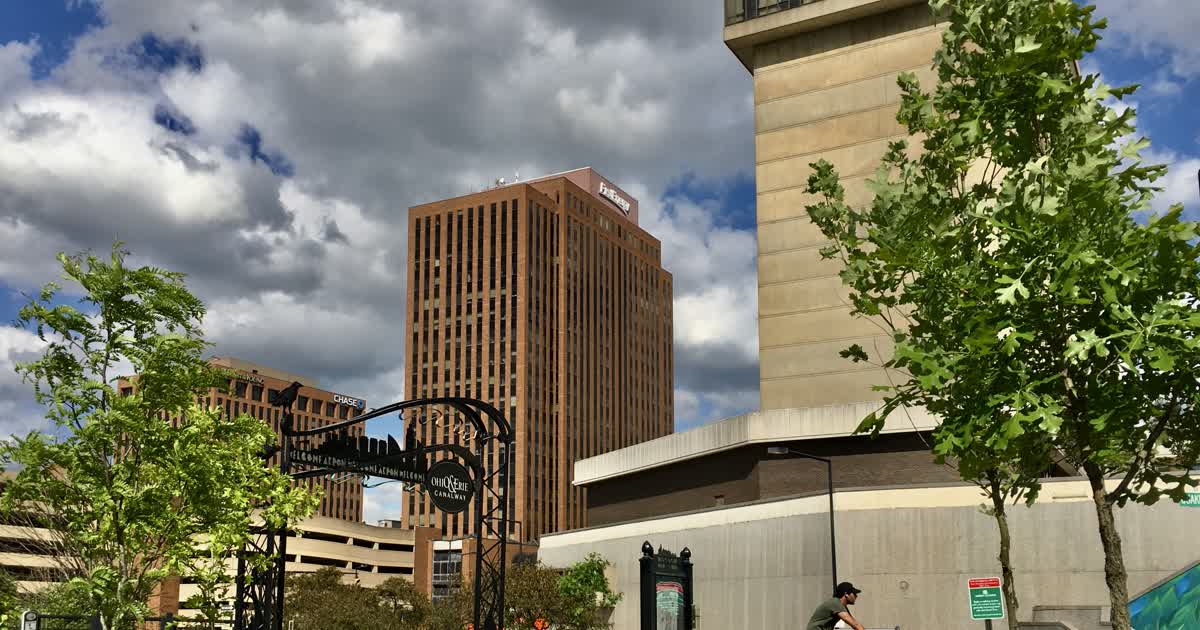
The building’s passing is one more change in a Cascade Valley that still wears its canal-era history openly. Readers following Akron’s neighborhoods can also read our coverage of the 45th Holiday Tree Festival at Akron Children’s and the city’s $2,000 grants to 50 youth sports and wellness groups.
What happens next is the demolition itself. When the wreckers finish at 198 Cuyahoga Street, a building that fed a neighborhood’s bodies for six decades and its spirit for six more will exist only in the record the Beacon Journal assembled — first a store, then a church, now a memory.
Photo: Andre Carrotflower, CC BY-SA